

xCloud.host market opportunity is the core topic of this updated guide. This xCloud.host Market Opportunity: A Case Study for Hosting Providers article now opens with the target phrase clearly, then keeps the rest of the analysis focused on practical value, decision points, and next steps.
Written by Swadhin Khan. Published as a strategic hosting case study.

xCloud.host market opportunity is not just a product question. It is a bigger hosting-market question: can a modern WordPress-first cloud panel help agencies, freelancers, and traditional hosting providers move from low-margin shared hosting into higher-value managed hosting?
The short answer is yes, but only if xCloud.host sharpens its positioning. The opportunity is not to become another generic server control panel. The stronger opportunity is to become a business platform for WordPress agencies, reseller hosts, shared hosting providers, and managed VPS companies.
Executive Summary
- WordPress powers about 41.5% of all websites and about 59.2% of websites using a known CMS, based on W3Techs WordPress usage data.
- The global web hosting services market was estimated at $149.30 billion in 2025 and projected to reach $661 billion by 2034 at around 17.8% CAGR, according to Fortune Business Insights.
- xCloud.host can win by focusing on managed WordPress cloud hosting, white-label reseller workflows, migration, backup, security, team access, and agency operations.
- Existing shared hosting and managed VPS providers can use xCloud as a premium product layer instead of replacing their current cPanel, DirectAdmin, Webuzo, WHMCS, or VPS business immediately.
Why This Market Is Open Right Now

Traditional hosting panels solved an older problem: give users a place to manage domains, email, databases, FTP, SSL, and basic hosting accounts. That is still useful, but the buyer expectation has changed. A growing number of website owners do not want to become server administrators. They want speed, staging, backups, migration, security, simple PHP management, client access, and a clean business workflow.
That is where xCloud.host has room to grow. Its public positioning already leans into WordPress hosting, cloud server management, migration, staging, backup, security, team collaboration, and reseller/white-label hosting. Those are not small features. For an agency or hosting provider, they are revenue features.
The best market position for xCloud is not ‘another control panel.’ It should be: start and manage a white-label WordPress hosting business without becoming a server admin.
Competitor Comparison

| Panel | Current strength | Where xCloud can compete |
|---|---|---|
| Webuzo | Traditional multi-user hosting control panel, useful for domains, databases, apps, email and reseller-style hosting. See Webuzo. | Modern WordPress workflows, agency hosting, white-label cloud packages, managed migrations, and easier client-facing hosting operations. |
| Enhance | Strong modern hosting-provider infrastructure, multi-server operations, placement logic and scaling. See Enhance features. | xCloud must prove agency/reseller value with public benchmarks, uptime reports, case studies, migration results, and hosting-company partner stories. |
| DirectAdmin | Mature, lightweight, affordable classic control panel with official plans around $5, $15, and $29/month. See DirectAdmin pricing. | Win customers who care less about classic shared hosting administration and more about managed WordPress cloud outcomes. |
| aaPanel | Popular because it is free or low-cost for VPS users and simple to start with. See aaPanel features. | Target professional users who need support, reliability, client management, backups, security, and business-grade workflows. |
| CyberPanel | Attractive because of OpenLiteSpeed and low entry cost. See CyberPanel features. | Win on trust, backup, update discipline, and security messaging. Public CyberPanel CVEs such as CVE-2024-51378 and CVE-2024-51567 show why serious providers care about security process. |
| cPanel/Plesk | Still very strong in traditional hosting, but many smaller providers feel pressure from licensing cost, account-based pricing, and old shared-hosting competition. | Offer a focused managed WordPress cloud product line that does not need to replace the provider’s whole existing stack on day one. |
You may also read

foodpanda Bangladesh Case Study: সুবিধা, অসুবিধা ও প্রতিযোগিতামূলক বিশ্লেষণ
foodpanda Bangladesh case study: food delivery, grocery, pandamart, coverage, customer experience, competitor analysis এবং ব্যবসায়িক শিক্ষা।
How Existing Hosting Providers Can Benefit
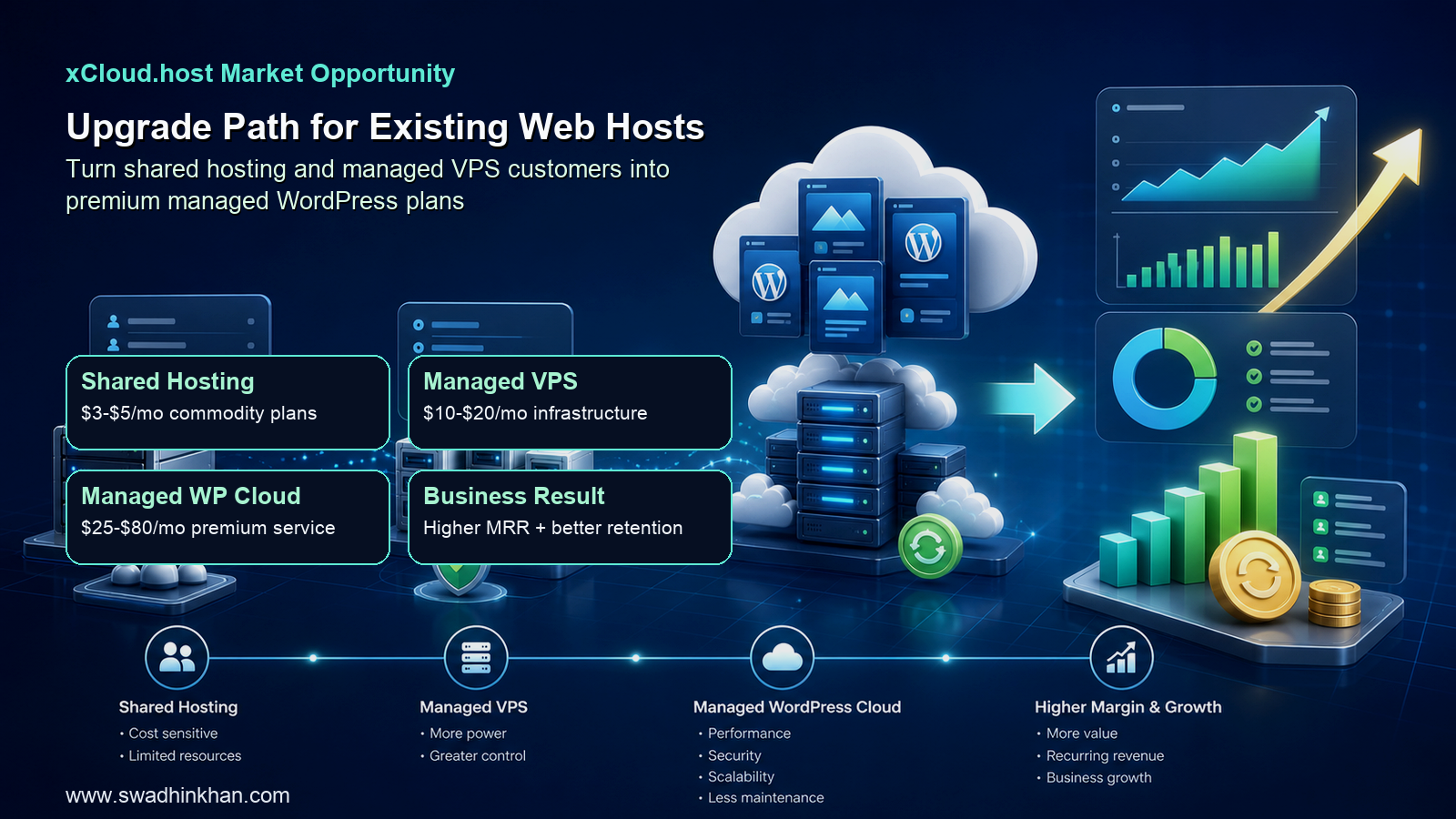
This is the most important commercial angle. xCloud should not only sell to individual website owners. It should sell to existing web hosting providers that already have customers, servers, support teams, domain revenue, billing systems, and brand trust.
A traditional host can keep selling shared hosting, reseller hosting, domains, email, and managed VPS. Then it can add a premium line such as Managed WordPress Cloud Hosting powered by xCloud. This gives the provider a modern offer without rebuilding a full SaaS platform from zero.
- Higher revenue per customer: a provider selling $3-$5/month shared hosting can introduce $15-$50/month managed WordPress plans for serious site owners and agencies.
- Better VPS monetization: raw VPS customers often need help with PHP, SSL, cache, backups and WordPress performance. xCloud can turn unmanaged infrastructure into a managed experience.
- Lower support pressure: if customers can handle SSL, staging, backup, site migration and PHP management from a cleaner dashboard, basic support tickets can reduce.
- Agency and reseller growth: agencies need white-label hosting, team access, client management and recurring income more than they need a raw Linux panel.
- Migration campaigns: hosts can promote upgrades like ‘move from slow shared hosting to managed WordPress cloud hosting’ and keep customers before they leave for Cloudways-style competitors.
- Retention: once customers rely on backups, staging, team access and managed workflows, switching becomes less attractive.
Simple Revenue Example for a Hosting Company
Assume a small hosting provider has 1,000 shared hosting customers paying an average of $4/month. That is about $4,000 MRR. If only 10% of those customers upgrade into a managed WordPress plan at $25/month, that creates $2,500 MRR from 100 upgraded customers. If the provider keeps the original shared plan as a base or bundles support carefully, the blended account value can rise significantly.
You may also read

Kirki Review: Features, Pricing, Pros, Cons & Who It’s For
Quick answer: This Kirki review finds that Kirki is a visual, freeform WordPress website builder for people who want more layout freedom than a conventional template-first workflow. Its free
For a managed VPS provider, the math can be even stronger. A $10-$20 VPS can become a $30-$80 managed WordPress package when it includes site management, security, backup, performance tuning and migration support. xCloud’s opportunity is to make this packaging easier for providers.
Best Country Opportunities

| Market tier | Countries | Why it matters |
|---|---|---|
| Tier 1 | United States, United Kingdom, Canada, Australia, Germany, Netherlands | High WordPress usage, higher agency budgets, mature SaaS payments, strong demand for managed hosting and white-label client services. |
| Tier 2 | India, Bangladesh, Pakistan, Philippines, Indonesia, Vietnam, Malaysia | Large freelancer and agency base, price-sensitive but high-volume reseller hosting demand, fast SME website adoption, and strong WordPress developer communities. |
| Tier 3 | UAE, Saudi Arabia, Brazil, Mexico, Nigeria, Kenya, South Africa | Growing SME digitalization, ecommerce adoption, agency markets, and demand for simpler managed hosting infrastructure. |
North America is especially valuable because Fortune Business Insights reported it held around 41% of the global web hosting services market in 2025. But Asia-Pacific and emerging markets may be where xCloud can scale faster if pricing, payment methods, onboarding, and local partner programs are handled correctly.
What xCloud Is Doing Right
- It is WordPress-first, which matches the largest CMS opportunity in the market.
- It is cloud-first, which fits the shift away from old shared hosting limitations.
- It has a natural agency/reseller story through white-label hosting and team workflows.
- It can appeal to non-sysadmin users who want managed outcomes, not server complexity.
- Its official material already highlights features like managed hosting, migration, backups, staging and reseller hosting. See xCloud features and xCloud reseller hosting.
Where xCloud Should Improve
The biggest mistake I see is not the product direction. It is the message. xCloud sometimes feels like it is trying to describe too many things at once: WordPress hosting, PHP hosting, Laravel, Node.js, n8n, AI hosting, Lovable hosting and more. These can be good capabilities, but the front-market message should be sharper.
- Sharper positioning: lead with white-label managed WordPress hosting for agencies and providers.
- Public proof: publish uptime reports, migration numbers, speed benchmarks and real agency case studies.
- Hosting-provider program: create a partner plan specifically for shared hosting and managed VPS companies.
- Migration campaigns: target Cloudways, cPanel, DirectAdmin, Webuzo, CyberPanel and aaPanel users with clear switching pages.
- Country pricing: create regional pricing or partner bundles for India, Bangladesh, Pakistan, Southeast Asia, UAE and Africa.
- Billing integrations: WHMCS, WooCommerce, Stripe, Paddle, Dodo Payments and local payment gateways can make xCloud easier to sell as a business platform.
- Security transparency: public changelogs, patch policy and backup/recovery proof will matter against free and low-cost panels.
Strategic Mistakes in the Current Market
Many traditional panels still sell infrastructure features when the buyer wants a business outcome. A small agency does not wake up wanting to manage vhosts and PHP workers. It wants to onboard a client, migrate a site, send an invoice, keep backups, show performance, and avoid emergency support calls.
You may also read

Case Study: How RetailHub Increased Sales by 35% with Live Chat
RetailHub live chat improvements helped increase sales by 35 percent through faster replies, better chat workflows, and stronger customer engagement.
Free and low-cost panels often win the first install, but they do not always win long-term trust. Mature panels win stability, but they can feel too traditional for modern WordPress agencies. Modern panels like Enhance already understand the hosting-provider story, so xCloud needs to compete with a clearer agency and reseller narrative, not just a feature list.
My Practical View
This case study comes from my practical experience with WordPress hosting, WHMCS/client billing, DNS, cPanel/DirectAdmin-style shared hosting, managed VPS support, migrations, backup workflows, reseller hosting, and customer support operations.
From that experience, I believe xCloud.host has a real global market opportunity. But the winning path is not to copy every existing panel. The winning path is to help hosting providers and agencies package better managed WordPress hosting offers, raise average revenue per customer, reduce basic support friction, and keep clients inside a branded hosting experience.
Final Strategic Recommendation
xCloud should become the easiest way for agencies and hosting providers to launch a premium white-label WordPress cloud hosting business.
If xCloud focuses on that message, the market becomes much clearer. It can still support PHP, Laravel, automation and broader app hosting over time. But the main buying reason should be simple: sell, manage and scale WordPress hosting without forcing every provider or agency to become a server operations company.
That is where the opportunity is. Not only in control panel software, but in helping traditional hosting businesses move from commodity shared hosting into higher-margin managed cloud hosting.
FAQ
Is xCloud.host better than cPanel or DirectAdmin?
It depends on the use case. cPanel and DirectAdmin are stronger for classic shared hosting administration. xCloud.host has a stronger opportunity for managed WordPress cloud hosting, agency workflows, reseller hosting, staging, backups and simplified client management.
Can a traditional hosting provider use xCloud without replacing its current panel?
Yes. That is one of the best strategies. A provider can keep cPanel, DirectAdmin or Webuzo for existing shared hosting and add xCloud as a premium managed WordPress cloud hosting layer.
Which customers are best for xCloud?
The best customers are WordPress agencies, freelancers, reseller hosts, small hosting companies, managed VPS providers and website owners who want a managed experience instead of raw server administration.
What should xCloud improve first?
The first improvement should be positioning. The product should speak more directly to agencies and hosting providers with proof: revenue examples, migration success stories, uptime reports, benchmarks and reseller case studies.
Why is the global opportunity strong?
The opportunity is strong because WordPress remains the largest CMS category, the web hosting market is projected to grow quickly, and many hosting providers need higher-margin offers beyond low-cost shared hosting.
Sources
- W3Techs WordPress usage statistics
- Fortune Business Insights web hosting services market
- xCloud.host features
- xCloud.host reseller hosting
- Webuzo official website
- Enhance features
- DirectAdmin pricing
- aaPanel features
- CyberPanel features
- NVD CVE-2024-51378
- NVD CVE-2024-51567
You may also read

Blip AI Lifetime Deal Review: 2026 Verdict & Pricing
Blip AI lifetime deal review for teams comparing AI chatbots, support agents, lead capture, pricing, pros, cons, and AppSumo value.
Related hosting and growth reading
If you are comparing hosting business models, also read the .bd domain Bangladesh case study, the Shopify and WordPress integration update, and the customer support to sales opportunities guide.